The honeycomb-type tungsten alloy grating designed and manufactured by CTIA GROUP is a functional component with tungsten alloy as the base material and internal channels arranged in a regular hexagonal honeycomb pattern. The unit channels are closely connected, and adjacent channels share side walls. The overall structure is uniform and orderly, belonging to a high-density material component with strong shielding capability. Relying on its unique structural advantages, it plays an important role in high-energy radiation shielding, high-end scientific research experiments, and industrial inspection fields.
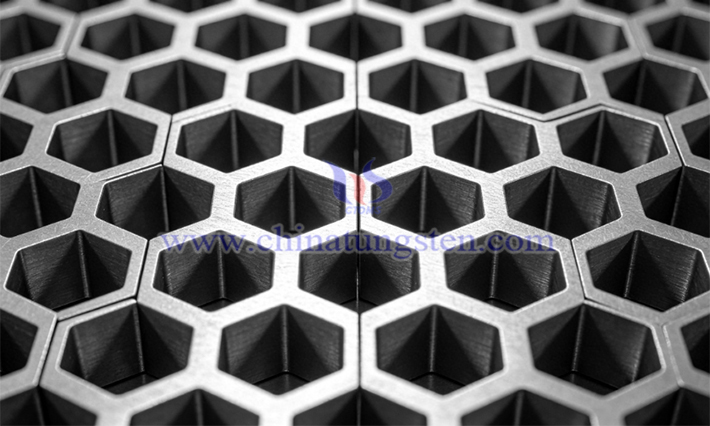
Honeycomb-type Tungsten Alloy Grating Picture
CTIA GROUP and its parent company, CHINATUNGSTEN ONLINE, have been dedicated to the tungsten-molybdenum products industry for nearly 30 years. They specialize in providing flexible, customized global services for tungsten-molybdenum products, designing, manufacturing, and precisely processing various standard specifications, grades, and dimensional precision according to customer requirements, suitable for a wide range of applications. For more information on tungsten alloy grids, please visit the website: http://www.tungsten-alloy.com/index.htm. If you require tungsten alloy grids, please contact CTIA GROUP: sales@chinatungsten.com, 0592-5129595.
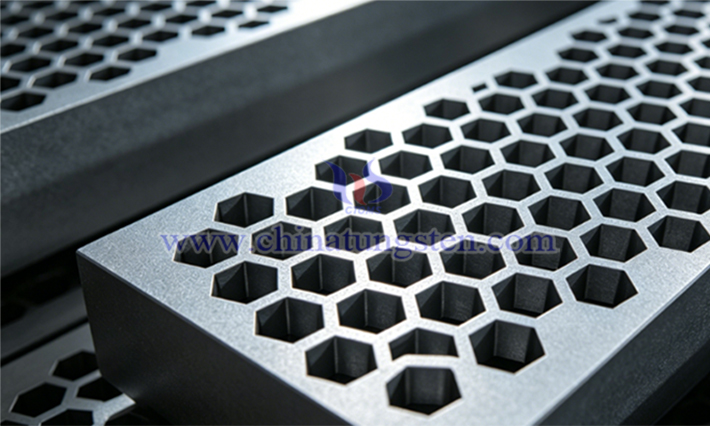
Honeycomb-type Tungsten Alloy Grating Picture
I. Structural characteristics of the honeycomb-type tungsten alloy grating
The core structure of the CTIA GROUP honeycomb-type tungsten alloy grating consists of absorbing units, spacing regions, and supporting and fixing parts. The three work in coordination to ensure radiation regulation performance while maintaining overall structural stability.
The absorbing units are made of high-density tungsten alloy, forming the side walls of the hexagonal cavities, with a material density typically ranging from 17.5–18.6 g/cm3, providing excellent high-energy radiation shielding capability. The spacing regions are located between adjacent cavities and are generally made of aluminum, carbon fiber, or other low-density and low-absorption-coefficient materials. Their main function is to provide channels for direct radiation and avoid additional obstruction of effective radiation. The supporting and fixing parts adopt composite materials with thermal expansion coefficients matched to the spacing regions, and the overall structure is bonded or laminated through adhesive or lamination processes, effectively maintaining dimensional accuracy and positional stability, and preventing structural deformation caused by temperature changes or external forces.
The honeycomb structure forms a regular two-dimensional hexagonal array with high transmittance and better space utilization efficiency compared with some traditional grid structures. Its symmetrical arrangement ensures relatively balanced radiation channel conditions in all directions, allowing it to filter scattered radiation within the plane and maintain a stable radiation transmission state, meeting the requirements of multi-directional radiation control.
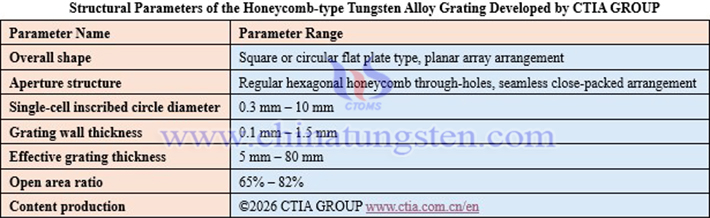
Structural Parameters of the Honeycomb-type Tungsten Alloy Grating Developed by CTIA GROUP
II. Material properties of the honeycomb-type tungsten alloy grating
The honeycomb-type tungsten alloy grating developed by CTIA GROUP relies on the excellent properties of tungsten-based alloy materials to achieve efficient radiation shielding and long-term stable service. According to composition differences, tungsten-based alloys are mainly divided into tungsten-nickel-iron alloys and tungsten-nickel-copper alloys, which differ in performance. The key difference is that tungsten-nickel-iron alloys are magnetic, while tungsten-nickel-copper alloys are non-magnetic.
Generally, tungsten-based alloys have a high melting point and excellent high-temperature resistance, enabling long-term use in high-energy radiation environments without significant performance degradation caused by temperature rise. In addition, tungsten-based alloys also exhibit strong wear resistance and deformation resistance. The honeycomb structural design allows the grating to maintain high-density shielding performance while optimizing material usage. The structure has high stability and can withstand external forces during normal installation and operation, making it less prone to obvious deformation or damage.
III. Manufacturing methods of the honeycomb-type tungsten alloy grating
The main manufacturing methods of the honeycomb-type tungsten alloy grating developed by CTIA GROUP include powder metallurgy and additive manufacturing (laser powder bed fusion). Powder metallurgy process: first, tungsten powder, nickel powder, and iron powder are proportioned, mixed thoroughly, and then dried. The mixed powder is pressed into shape using a mold to obtain a regular honeycomb-shaped green body. It is then sintered in a dedicated furnace under controlled atmosphere to gradually densify and solidify the compact. After sintering, planar finishing and through-hole precision machining are performed to form the honeycomb cavity structure, followed by cleaning, polishing, and final inspection.
Additive manufacturing process: first, a 3D model of the honeycomb-type tungsten alloy grating is designed, and the support structures are optimized before slicing into layers and planning the build path. The mixed powder (tungsten powder, nickel powder, and iron powder) is loaded into the forming equipment. Under a protective atmosphere, the powder is selectively melted layer by layer using a laser to build up the honeycomb structure. After forming, stress-relief heat treatment is carried out, followed by post-processing such as deburring, polishing, cleaning, and drying, and finally quality inspection is performed.
IV. Applications of the honeycomb-type tungsten alloy grating
In the field of high-energy physics experiments, the honeycomb-type tungsten alloy grating is commonly used in particle accelerators and monochromators of X-ray diffraction instruments. For example, in high-energy particle detection experiments, the honeycomb-type tungsten alloy grating is used to filter multi-directional scattered radiation, improving the stability of detection signals and effectively ensuring the reliability of experimental data. Its two-dimensional symmetrical structure and uniform radiation control capability efficiently shield stray radiation, providing a clean signal environment for experimental analysis.
In industrial scenarios such as semiconductor inspection and metal component flaw detection, the honeycomb-type tungsten alloy grating can be installed at the detector end of inspection equipment to filter scattered radiation interference and improve the clarity of detecting micro-defects and internal quality. For example, in thick-walled metal component inspection, by adjusting the grating wall height and aspect ratio (the ratio of cavity depth to width), the blocking effect on obliquely incident scattered radiation can be enhanced, thereby enabling the detection of internal micro-cracks. Its hexagonal cavity structure can adapt to inspection requirements of workpieces of different sizes, offering strong versatility.
In high-end medical imaging equipment such as CT scanners and X-ray machines, the honeycomb-type tungsten alloy grating can serve as an anti-scatter component to help optimize image contrast and detail performance. Compared with one-dimensional parallel gratings, its two-dimensional structure can regulate scattered radiation paths from multiple angles, making it suitable for large-area detection scenarios.
V. Usage precautions and maintenance requirements of the honeycomb-type tungsten alloy grating
To ensure the service life and performance of the honeycomb-type tungsten alloy grating, the following precautions and maintenance requirements should be followed: 1) During installation, avoid external impact on the grating walls, especially ultra-thin wall structures, to prevent deformation or damage that may affect radiation filtering performance; 2) The operating environment should avoid corrosive media such as strong acids and strong alkalis to prevent corrosion between the tungsten alloy and spacing materials, which may lead to structural loosening; 3) After long-term use in high-temperature or high-radiation environments, regular calibration should be performed to ensure cavity dimensions and array spacing meet design requirements; 4) During routine maintenance, the surface dust can be wiped with a dry soft cloth, and hard tools should be avoided to prevent surface damage.