CTIA GROUP’S tungsten carbide rods have good high-temperature resistance, which is mainly reflected in their ability to maintain hardness and strength at elevated temperatures, known as red hardness. According to industry technical data, cemented carbide can still maintain relatively high hardness in the temperature range of 800°C to 1000°C, with hardness values equivalent to above 60 HRC. This performance characteristic significantly distinguishes it from high-speed steel—high-speed steel begins to show a significant decrease in hardness at around 650°C, whereas tungsten carbide has a higher service temperature limit. However, the high-temperature performance of tungsten carbide rods is constrained by the service environment (such as whether oxygen is present), and varies under different conditions.
CTIA GROUP and its parent company, CHINATUNGSTEN ONLINE, have been dedicated to the tungsten-molybdenum products industry for nearly 30 years. They specialize in providing flexible, customized global services for tungsten-molybdenum products, designing, manufacturing, and precisely processing various standard specifications, grades, and dimensional precision according to customer requirements, suitable for a wide range of applications. For more information on tungsten carbide, please visit the website: http://www.tungsten-carbide.com.cn/index.html. If you require tungsten carbide, please contact CTIA GROUP: sales@chinatungsten.com, 0592-5129595.
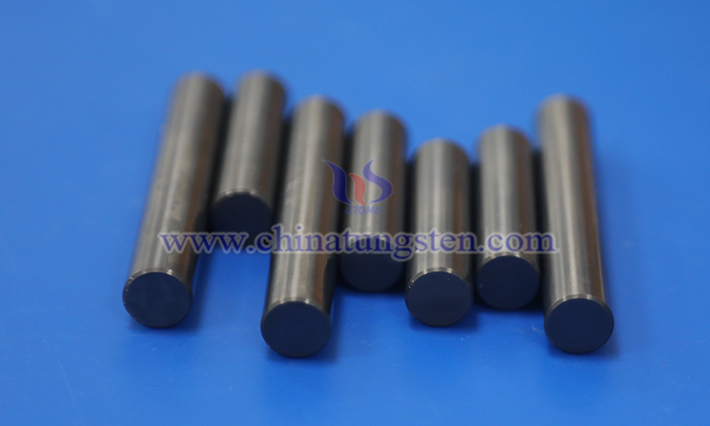
CTIA GROUP’S tungsten carbide rods picture
I. Red hardness of tungsten carbide rods
Red hardness refers to the ability of a material to maintain its hardness at high temperatures, which is one of the key performance characteristics distinguishing tungsten carbide rods from traditional tool steels. In inert gas or vacuum environments, tungsten carbide rods can still maintain high hardness and strength at 800°C to 1000°C. Tungsten carbide (WC), as the hard phase, has a melting point of approximately 2870°C, while the cobalt (Co) binder phase has a melting point of 1495°C. The overall material maintains structural stability at around 1000°C.
II. Oxidation resistance temperature of tungsten carbide rods
The service temperature of tungsten carbide rods in oxygen-containing environments is limited by their oxidation resistance, which is the main constraint on their high-temperature performance.
In air, tungsten carbide rods begin to show significant oxidation above 600°C to 800°C. According to academic studies, no oxidation is observed in ultrafine cemented carbide when heated to 400°C or below; when the temperature rises to 500°C and above, obvious oxidation occurs and the surface becomes rough. During oxidation, the cobalt binder reacts with oxygen in the atmosphere to form oxides (such as CoWO? and WO?), while tungsten carbide oxidizes to form a loose WO? layer, leading to surface powdering.
In a low-vacuum environment, the oxidation resistance of tungsten carbide rods improves, with oxidation occurring only at temperatures above 600°C, and the oxide layer being thinner. Studies show that when heated to 500°C, CoWO? and WO? phases appear on the surface of tungsten carbide.
III. Effect of high temperature on the transverse rupture strength of tungsten carbide rods
The transverse rupture strength of CTIA GROUP’S tungsten carbide rods decreases with increasing temperature, and this change is related to both temperature and microstructural evolution. Experimental results show that at room temperature, the transverse rupture strength is approximately 3526 to 3726 MPa; at 500°C, it decreases to about 2220 MPa; at 600°C, it is about 2006 to 2194 MPa; at 700°C, it is about 1738 to 1836 MPa; and at 800°C, it is about 1510 to 1627 MPa.
At 900°C, a relatively thick oxide layer forms on the surface of the tungsten carbide bending specimens, which is one of the reasons for the significant reduction in transverse rupture strength at this temperature. Meanwhile, at lower temperatures, tungsten carbide exhibits brittle fracture characteristics, whereas at 900°C, the specimens show plastic deformation behavior.
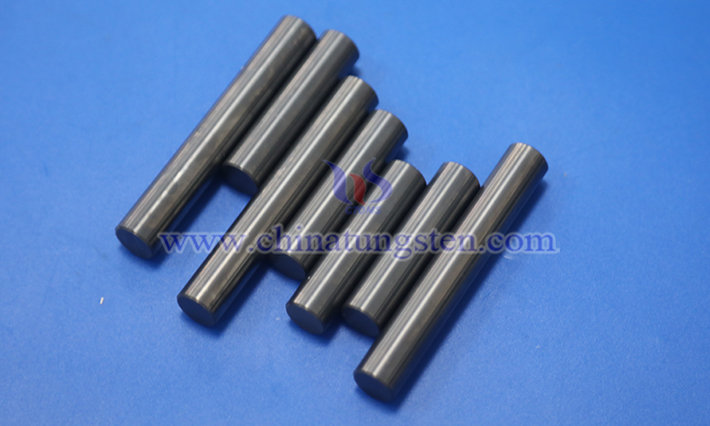
CTIA GROUP’S tungsten carbide rods picture
IV. Factors affecting the high-temperature performance of tungsten carbide rods
Cobalt content is a key parameter affecting the high-temperature performance of tungsten carbide rods. Generally, grades with lower cobalt content have better hardness retention at high temperatures but reduced toughness. In nanocrystalline cemented carbide systems, cobalt content also significantly influences high-temperature performance. Grades with 8% to 10% cobalt show a relatively good balance of high-temperature properties.
Fine grain size helps improve the high-temperature performance of cemented carbide. By increasing grain boundary density, fine grains can effectively hinder thermal fatigue crack propagation.
The addition of chromium carbide (Cr?C?) is an effective method to enhance high-temperature performance. At high temperatures, Cr?C? dissolves into the Co phase and forms a Cr?O? layer, which improves grain boundary strength. After adding Cr?C?, thermal fatigue crack length can be reduced by about 40%, and creep strain rate can be reduced by about 40%.
Physical vapor deposition (PVD) or chemical vapor deposition (CVD) coatings can significantly improve the oxidation resistance temperature of tungsten carbide rods. With coatings such as Al?O? and TiAlN, the service temperature can be increased to 1000°C–1200°C.