The red hardness of cemented carbide rods designed and produced by CTIA GROUP refers to the material’s ability to maintain its hardness and cutting or wear resistance at elevated temperatures (approaching a red-hot state). This property reflects the stability of a material’s resistance to softening under thermal exposure and is one of the key characteristics that distinguish cemented carbides from tool materials such as high-speed steel.
CTIA GROUP and its parent company, CHINATUNGSTEN ONLINE, have been dedicated to the tungsten-molybdenum products industry for nearly 30 years. They specialize in providing flexible, customized global services for tungsten-molybdenum products, designing, manufacturing, and precisely processing various standard specifications, grades, and dimensional precision according to customer requirements, suitable for a wide range of applications. For more information on tungsten carbide, please visit the website: http://www.tungsten-carbide.com.cn/index.html. If you require tungsten carbide, please contact CTIA GROUP: sales@chinatungsten.com, 0592-5129595.
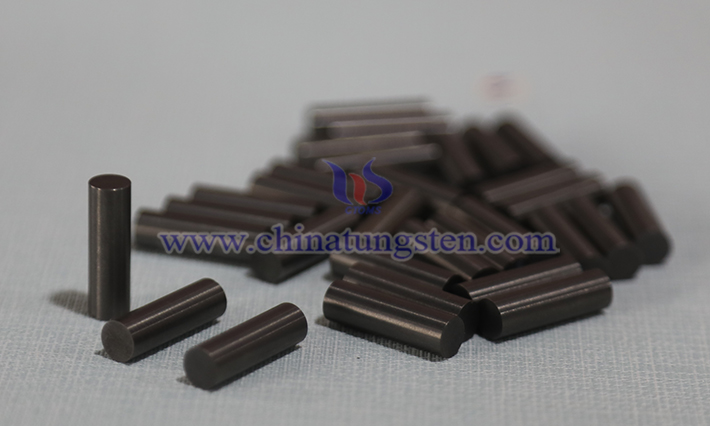
Images of cemented carbide rods manufactured by CTIA GROUP
Since cemented carbide rods use tungsten carbide as the main hard phase and cobalt as the binder phase, their crystal structure and phase composition remain relatively stable at high temperatures, allowing them to retain a good hardness level within elevated temperature ranges.
The red hardness of cemented carbide mainly originates from its composite structure of a “hard-phase skeleton and metallic binder filling.” WC, as the primary hard phase, has a high melting point and strong covalent bonding characteristics. It does not easily undergo lattice slip at high temperatures, thereby maintaining structural rigidity at the microscopic level. The rigid skeleton formed by interconnected WC grains provides the foundation for high-temperature load-bearing capacity. Although the Co binder phase decreases in strength and hardness at elevated temperatures, its function is not only to bond WC grains but also to provide stress buffering and energy dissipation. As temperature rises, the Co phase softens; however, its flow is constrained by the WC network structure, preventing rapid overall material failure. In addition, the stability of the WC/Co interfacial bonding at high temperatures also affects crack initiation and propagation behavior, thereby indirectly influencing red hardness performance.
As temperature increases, the performance of cemented carbide rods generally degrades gradually rather than failing abruptly. In the range of approximately 400–600°C, the material is still mainly supported by the WC skeleton, while the Co phase only shows slight softening, so the reduction in hardness is limited and wear resistance remains relatively good. When the temperature rises further to around 700–800°C, the softening effect of the Co phase becomes more pronounced, and grain boundary diffusion accelerates, reducing local structural stability and significantly weakening resistance to plastic deformation. At even higher temperatures, especially under oxidation or thermomechanical coupling effects, surface performance degradation may accelerate.
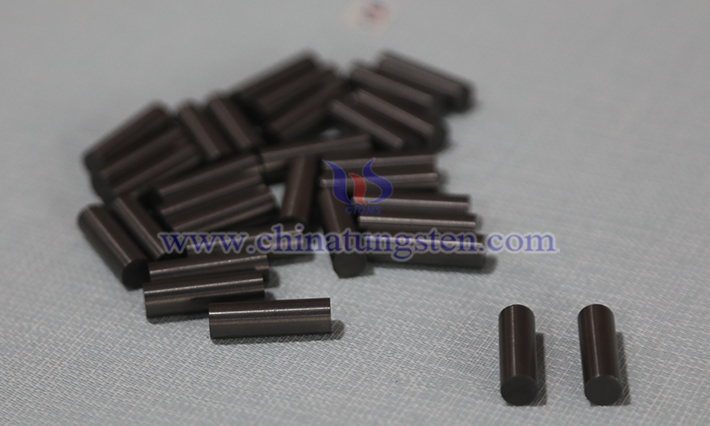
Images of cemented carbide rods manufactured by CTIA GROUP
The red hardness of cemented carbide rods is not a fixed material constant but a structural property closely related to microstructure. Fine-grained cemented carbides, due to their smaller grain size and larger grain boundary area, can effectively restrict dislocation motion and localized plastic deformation at high temperatures, thus exhibiting better hardness retention within a certain range. However, excessively fine grains may also lead to a thinner Co phase distribution, which can limit toughness to some extent.
Cemented carbides with lower Co content generally exhibit better red hardness due to reduced binder phase softening effects. However, this also results in insufficient plastic buffering during crack propagation, leading to reduced impact resistance.
Carbide additives (such as TiC, TaC, NbC, etc.) mainly improve structural stability by inhibiting WC grain growth and enhancing grain boundary pinning effects. Under high-temperature conditions, this grain stabilization mechanism helps slow down microstructural coarsening, thereby improving the retention of red hardness.
In addition, sintering processes (such as vacuum sintering or hot isostatic pressing, HIP) also indirectly influence red hardness by controlling porosity, since pores can act as stress concentration sites at high temperatures and accelerate performance degradation.