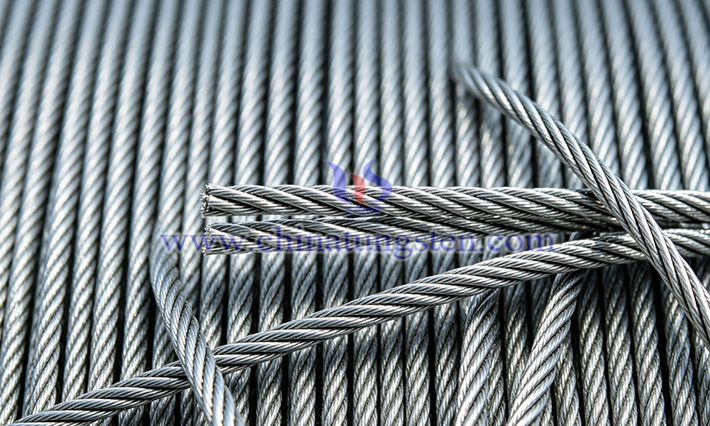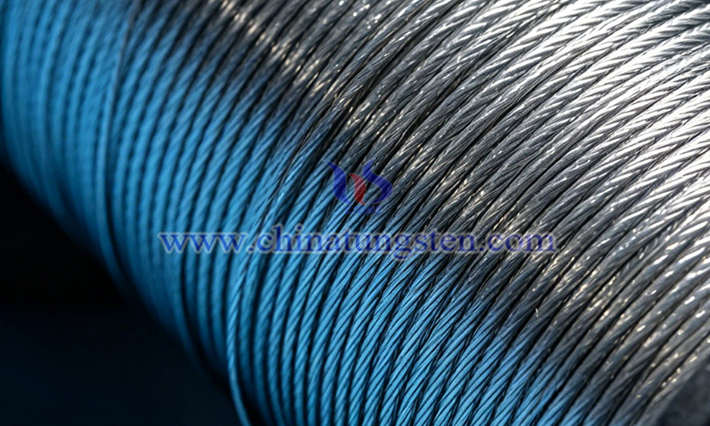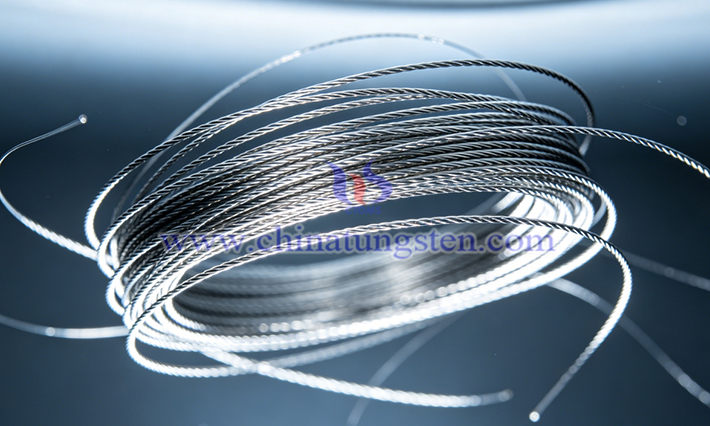
The performance of tungsten wire tendon ropes is determined by the extreme physicochemical characteristics of the base material (tungsten) combined with a multi-strand braided structure, offering unique advantages under harsh operating conditions involving high temperatures, heavy loads, and high fatigue stress. These properties are detailed below in terms of physicochemical characteristics and mechanical performance.
1. Physicochemical Characteristics
(1) Melting Point and Dimensional Stability: Tungsten has a melting point of approximately 3420°C and a density of 19.25 g/cm3. It exhibits extremely low vapor pressure at high temperatures and maintains excellent dimensional stability even above 2000°C. In vacuum or inert atmospheres, tungsten wire tendon ropes can withstand long-term operation in environments ranging from 1500°C to 2400°C.
(2) Thermal Response: In actual operating conditions, drive systems are subjected to cumulative thermal effects—such as heat conduction from the motor and localized frictional heating during prolonged operation. Despite this, tungsten wire tendon ropes maintain stable tension response and repeatable positioning accuracy, showing minimal performance drift due to temperature fluctuations.
(3) Corrosion Resistance: Tungsten possesses excellent corrosion resistance; it does not rust in humid air or chemical environments. Its resistance to chemical corrosion rivals that of stainless steel, making it suitable for use in salt-spray environments such as those encountered in marine vessels and deep-sea equipment.
(4) Room-Temperature Brittleness and Processing Challenges: It is important to note that at room temperature, tungsten exhibits high strength and hardness but is highly brittle. Although drawing it into fine filaments imparts some flexibility, it remains a brittle material; it only demonstrates plasticity and maintains high strength at elevated temperatures. This characteristic makes the design and processing of end-fittings for tungsten wire tendon ropes challenging and increases sensitivity to surface defects, resulting in higher production costs.
2. Mechanical Properties
(1) Room-temperature tensile strength: The tensile strength of pure tungsten wire can exceed 3,000–4,000 MPa; its Young's modulus far surpasses that of typical organic fibers and approaches that of high-modulus carbon fiber. Tungsten wire produced via certain advanced processes can even reach strengths of 5,000–6,000 MPa. The tensile strength is ≥1,800 MPa for pure tungsten wire and ≥2,200 MPa for doped tungsten wire. Stranded tungsten wire has a tensile strength of approximately 980 MPa, which is about 30% higher than that of stainless steel cable.
(2) Structural parameters and load-bearing capacity: Tungsten wire tendons typically feature multi-strand, multi-layer designs—such as 7×7, 7×19, or 4×19×7 configurations. This transition from individual wire to a structured assembly allows external loads to be distributed across multiple strands, significantly enhancing fracture resistance and overall reliability. Representative load-bearing capacities are as follows: for a 0.5 mm specification, the breaking force is approximately 490–550 N; for 1.8 mm, the breaking load is approximately 3,700 N at room temperature and 1,570 N at high temperature; for 2.0 mm, the breaking load is approximately 4,010 N at room temperature and 1,800 N at high temperature; for 2.5 mm, the breaking load is approximately 6,700 N at room temperature and 2,820 N at high temperature; for 3.0 mm, the breaking load is approximately 8,240 N at room temperature and 3,042 N at high temperature; and for 4.0 mm, the room-temperature load-bearing capacity is approximately 1,200 kg.
(3) Fatigue life: In precision transmission applications, medical-grade tungsten wire tendons with a diameter of approximately 0.5 mm can achieve a fatigue life exceeding 1 million cycles; this is a key reason why they are the preferred material for micro-mechanical cable systems in surgical robots.
(4) Creep resistance: The creep of tungsten wire tendons is significantly lower than that of ultra-high molecular weight polyethylene (UHMWPE) fibers—a characteristic crucial for maintaining precision during long-term robotic operation. Under high-temperature conditions, the creep deformation of individual filaments is partially absorbed by the stranded structure, manifesting as a slow, overall elongation rather than localized failure.