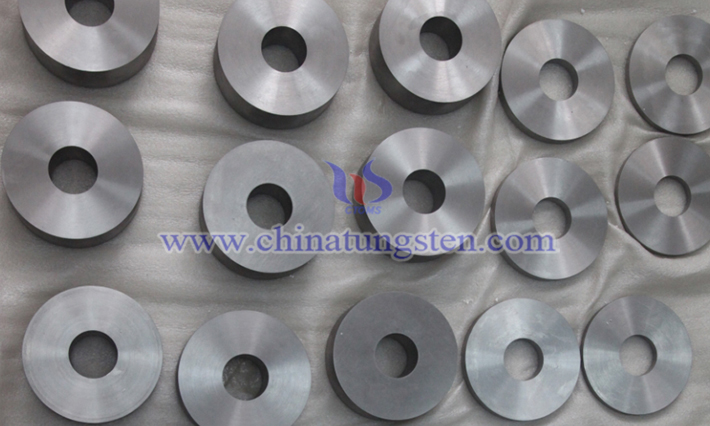
A conductive tungsten alloy ring is a high-density ring-shaped component made primarily of tungsten (W) (typically 85%~99%), with the addition of conductive metal elements such as nickel (Ni), iron (Fe), copper (Cu), and silver (Ag), manufactured using powder metallurgy. It combines the high density, high strength, and high melting point characteristics of tungsten, and by selecting different binder metal phases, different degrees of electrical and thermal conductivity can be achieved, meeting the dual requirements of high strength load-bearing capacity and stable electrical conduction in the electronics and electrical fields.
1. Performance of Conductive Tungsten Alloy Rings
As a high-density material, conductive tungsten alloy rings typically have a density between 16.5 and 18.8 g/cm3, far exceeding that of ordinary metals. This provides considerable mass within a limited space, making it particularly suitable for applications requiring miniaturization, high inertia, or precise control of the center of gravity.
Regarding electrical conductivity, by adjusting the types and proportions of elements such as copper and silver in the binder phase, the conductivity can be adjusted within the range of approximately 10% IACS (International Standard for Annealed Copper) to over 45% IACS. The tungsten-silver alloy ring exhibits the best conductivity, followed by the tungsten-nickel-copper ring, which is non-magnetic, while the tungsten-nickel-iron ring has slightly lower conductivity but higher strength.
In terms of magnetism, precise control can be achieved from weak magnetism to complete non-magnetism. The tungsten-nickel-copper alloy ring is a typical non-magnetic product, suitable for environments where magnetic interference is strictly prohibited, such as magnetic resonance imaging.
Furthermore, thanks to the high melting point of tungsten, the conductive tungsten alloy ring possesses excellent high-temperature resistance to arc erosion, maintaining surface integrity even under conditions of frequent switching on and off of high currents. Simultaneously, its thermal conductivity is much higher than that of ordinary mold steel, while its coefficient of thermal expansion is significantly lower than that of steel, helping to quickly dissipate working heat and reduce thermal stress.
In terms of mechanical properties, the tensile strength can reach 800~1500MPa, and the elongation is approximately 8%~25%, overcoming the defects of pure tungsten, such as high brittleness and difficulty in processing and forming, thus possessing good engineering practical value.
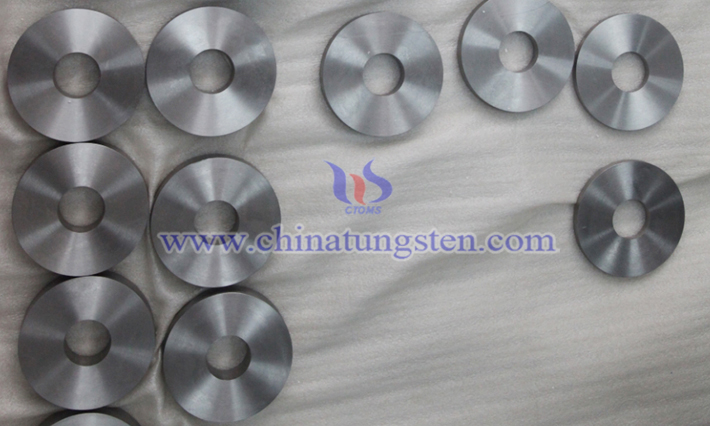
2. Applications of Conductive Tungsten Alloy Rings
In high-voltage power transmission and distribution equipment, conductive tungsten alloy rings are widely used as electrical contacts and protective rings in circuit breakers and disconnectors. They can withstand frequent interruptions of thousands of amperes of current and tens of thousands of volts of voltage, effectively resisting arc erosion, and have a significantly longer service life than traditional copper alloys.
In medical imaging equipment, tungsten-nickel-copper non-magnetic alloy rings are ideal for collimation and positioning rings in magnetic resonance imaging (MRI) systems, providing sufficient counterweight mass without interfering with the uniformity of the main magnetic field.
They are also commonly found in consumer electronics. For example, the linear vibration motors inside high-end smartphones and game controllers use miniature tungsten alloy rings as both high-density counterweights and conductive paths, achieving precise vibration feedback within a very small volume.
In the aerospace field, conductive tungsten alloy rings are used in gyroscope components of satellite attitude control systems, utilizing the large rotational inertia resulting from high density to improve control accuracy. They are also used as electromagnetic shielding rings in avionics equipment, effectively blocking mutual interference between radar imaging or communication signals.
In high-power semiconductor devices, tungsten-copper alloy rings with specific coefficients of thermal expansion are used as sealing rings and heat dissipation substrates for Insulated Gate Bipolar Transistor (IGBT) modules. This helps manage the high heat flux generated during chip operation, ensuring long-term stable device operation.
CTIA GROUP and its parent company, Chinatungsten Online, leverage 30 years of professional flexible customization experience to customize high-performance tungsten alloy products according to customer needs, covering a wide range of applications including radiation shielding, industrial sealing, precision instruments, aerospace, medical devices, defense, oil drilling, automotive manufacturing, electronic packaging, high-temperature furnaces, and nuclear protection. CTIA GROUP's tungsten alloy product website is www.tungsten-alloy.com, email is sales@chinatungsten.com, and phone is +86 592 5129595.