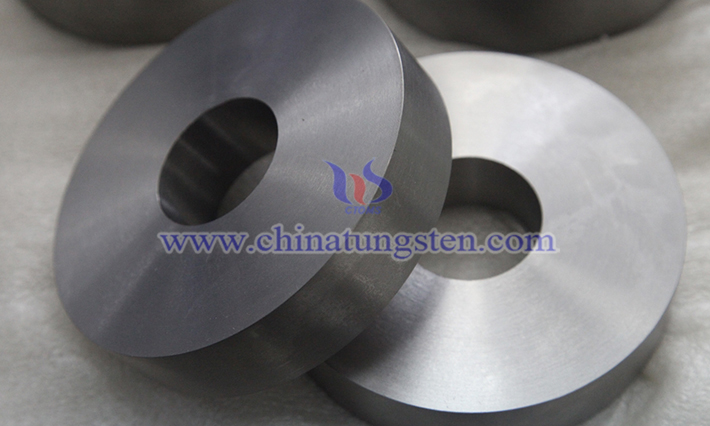
The production of conductive tungsten alloy rings differs from the casting or forging of ordinary metal materials because tungsten has an extremely high melting point (3422°C), and tungsten differs significantly from commonly used binder metals (nickel, copper, iron, silver, etc.) in melting point and density, making it difficult to achieve uniform alloying using conventional smelting methods. Therefore, industrially, two main manufacturing processes routes are used: powder metallurgy and melt infiltration, with the appropriate process flow selected based on the composition requirements of the final product.
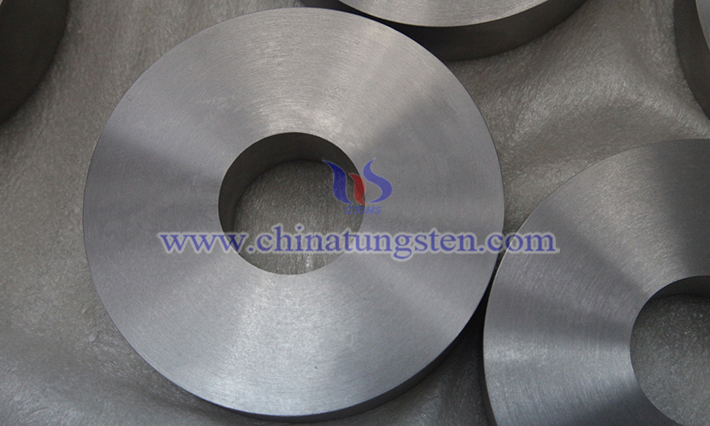
I. Preparation of Tungsten Alloy Rings by Powder Metallurgy
Powder metallurgy is the most common method for producing conductive tungsten alloy rings such as tungsten-nickel-iron (WNiFe) and tungsten-nickel-copper (WNiCu). It is suitable for alloy systems where the binder phase and tungsten can form a liquid phase at the sintering temperature.
Process Flow: First, high-purity tungsten powder is weighed with nickel powder, copper powder (or iron powder), etc., according to the designed proportions. The tungsten powder typically has a particle size of 2–5 micrometers, while the binder metal powder has a particle size of 3–8 micrometers. The mixing process employs a V-type mixer or ball mill for dry mixing, with mixing time generally controlled between 8 and 24 hours to ensure uniform distribution of the components. The mixed powder is then pressed into ring-shaped green bodies using either molding or cold isostatic pressing (CIP). Molding is suitable for smaller, simpler rings, with pressures typically ranging from 200 to 400 MPa; cold isostatic pressing is suitable for larger rings or those with thinner walls, with pressures reaching 300–600 MPa, achieving a more uniform density distribution.
The pressed ring-shaped green bodies are then sintered in a protective atmosphere. The most used atmosphere is pure hydrogen or decomposed ammonia to prevent oxidation of the tungsten and binder metal. The sintering temperature varies depending on the alloy composition: the liquid phase sintering temperature for tungsten-nickel-iron and tungsten-nickel-copper alloys is generally 1400°C–1600°C, with a holding time of 30–120 minutes. At this temperature, nickel-copper or nickel-iron forms a liquid phase, filling the voids between tungsten particles through capillary action. Simultaneously, particle rearrangement and dissolution-re-precipitation processes densify the ring. The density after sintering can reach over 98% of the theoretical density.
Subsequent processing: The surface of the sintered tungsten alloy ring may have slight oxidation or dimensional deviations, requiring machining. Due to the high hardness of tungsten alloys (approximately 200-350 HV), turning and grinding are typically performed using carbide tools or diamond abrasives to achieve the required dimensional accuracy and surface roughness. For applications requiring even higher dimensional accuracy, centerless grinding or internal/external cylindrical grinding processes are added.
II. Preparation of Tungsten Alloy Rings by Melt Infiltration Method
The melt infiltration method is mainly used to produce tungsten-copper alloy rings (WCu) and tungsten-silver alloy rings (WAg) because copper and silver have much lower melting points than tungsten, and both are immiscible or have extremely low solubility with tungsten, making it difficult to achieve high density using traditional liquid-phase sintering. The melt infiltration method effectively solves this problem.
Process Flow: First, a porous tungsten framework with continuous pores is prepared. Tungsten powder is mixed with a small amount of forming agent and pressed into a ring-shaped green body. Then, it is pre-sintered in a hydrogen atmosphere at approximately 1200°C to 1400°C. Pre-sintering creates sintering necks between the tungsten particles while maintaining an open porosity of 10% to 30%. Subsequently, copper or silver ingots are placed on the tungsten framework and heated in a protective atmosphere (hydrogen or vacuum) to a temperature higher than the melting point of copper (1083°C) or silver (961°C). The molten copper or silver automatically infiltrates into the pores of the tungsten framework through capillary action, achieving a filling rate of over 99%. Finally, excess infiltrated metal is removed from the surface through machining, resulting in a dense tungsten-copper or tungsten-silver alloy ring.
The advantages of the melt infiltration method are that it allows for precise control of the tungsten to conductive phase ratio, resulting in a uniform alloy microstructure, no residual porosity, and superior conductivity and density compared to products directly sintered using powder metallurgy.
III. Injection Molding Process for Tungsten Alloy Rings
For conductive tungsten alloy rings with complex shapes, miniaturized dimensions, or requiring mass production, metal injection molding (MIM) is increasingly being used. This process involves mixing tungsten powder and binder metal powder with an organic binder, injecting the mixture into a ring-shaped mold cavity to form a green body, removing the binder after degreasing, and finally sintering at high temperature. Injection molding achieves near-net-shape forming, reducing subsequent machining, and is particularly suitable for miniature conductive rings in electronic components. However, it requires high process control; the dimensional shrinkage rate (approximately 15%~20%) during degreasing and sintering needs to be accurately predicted and compensated for.
CTIA GROUP and its parent company, Chinatungsten Online, leverage 30 years of professional flexible customization experience to customize high-performance tungsten alloy products according to customer needs, covering a wide range of applications including radiation shielding, industrial sealing, precision instruments, aerospace, medical devices, defense, oil drilling, automotive manufacturing, electronic packaging, high-temperature furnaces, and nuclear protection. CTIA GROUP's tungsten alloy product website is www.tungsten-alloy.com, email is sales@chinatungsten.com, and phone is +86 592 5129595.