1. What is a Tungsten Carbide Safety Hammer Head
The tungsten carbide safety hammer head produced and designed by CTIA GROUP is the core functional component of a safety hammer. It belongs to the key part of an inlaid tungsten carbide type safety hammer, mainly used to break tempered glass and other brittle materials in emergency situations, providing auxiliary support for escape. It is commonly found in vehicle-mounted, public transportation, and other emergency escape tools.
CTIA GROUP and its parent company, CHINATUNGSTEN ONLINE, have been dedicated to the tungsten-molybdenum products industry for nearly 30 years. They specialize in providing flexible, customized global services for tungsten-molybdenum products, designing, manufacturing, and precisely processing various standard specifications, grades, and dimensional precision according to customer requirements, suitable for a wide range of applications. For more information on tungsten carbide, please visit the website: http://www.tungsten-carbide.com.cn/index.html. If you require tungsten carbide, please contact CTIA GROUP: sales@chinatungsten.com, 0592-5129595.
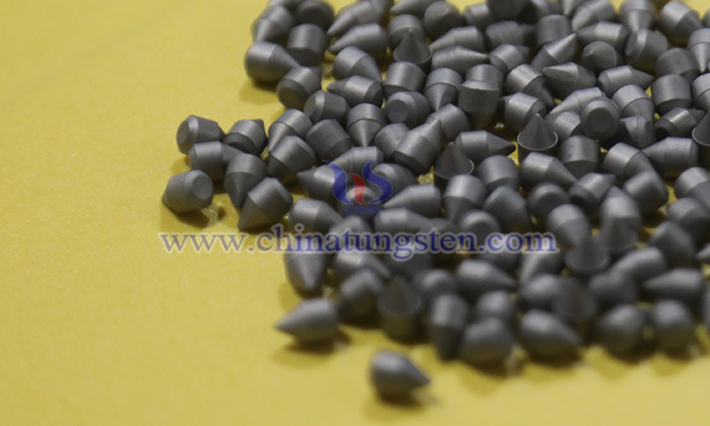
CTIA GROUP’s tungsten carbide safety hammer heads picture
The tungsten carbide safety hammer head uses tungsten carbide and other metal carbides as the matrix, with an appropriate amount of cobalt, nickel, or iron metal powders added as binders, and is formed through powder metallurgy processes. According to the national standard QB/T 5231-2018 for safety hammers, the striking end hardness of inlaid tungsten carbide type safety hammers has explicit requirements. Leveraging the material characteristics of the hammer head itself, it is suitable for various emergency glass-breaking scenarios and has significant performance advantages compared to hammer heads made of ordinary materials.
2. Material Composition and Performance Characteristics of Tungsten Carbide Safety Hammer Heads
The mainstream material for tungsten carbide safety hammer heads is WC-Co tungsten carbide, with some products adding elements such as tantalum and niobium to optimize performance. The designation “YG” refers to tungsten-cobalt tungsten carbide according to the national standard, with the following numbers representing the cobalt mass fraction. Common grades include YG6, YG8, and YG10X. This tungsten carbide material uses tungsten carbide as the hard phase and cobalt as the binder phase. The synergy of the two gives the hammer head excellent overall performance, with performance parameters referenced from industry standards and related material research data.
The overall hardness of tungsten carbide safety hammer heads ranges from HRA89 to 93, which is higher than high-speed steel. Under normal temperature and certain high-temperature conditions, the hardness remains stable. The tungsten carbide hard components in the material reduce wear during impact operations, allowing the hammer head tip to maintain a good shape after prolonged use, giving it a longer service life compared to traditional material hammer heads. Its wear resistance is superior to that of high-speed steel. The cobalt binder component provides a certain toughness, allowing the hammer head to withstand instantaneous impact loads and reduce the risk of cracking or chipping. Some grades have a bending strength of 2,400 to 2,800 N/mm2. Additionally, tungsten-cobalt tungsten carbide hammer heads have good chemical stability, being acid- and alkali-resistant, and exhibit low oxidation at high temperatures, making them suitable for various complex working environments. Even in humid or mildly corrosive conditions, the performance remains stable.
3. Structural Forms and Specifications of Tungsten Carbide Safety Hammer Heads
The structural forms of CTIA GROUP tungsten carbide safety hammer heads are mainly divided into integral and composite types. Both structures comply with general industry design specifications and adapt to different production and usage requirements. The integral hammer head is a single tungsten carbide component, with one end designed as a conical tip, typically with a cone angle of 60° to 90°, concentrating impact force. The other end is a cylindrical assembly section that can be embedded into the hammer handle, offering a simple structure and good assembly stability. The composite hammer head uses alloy steel as the main body, with the tungsten carbide tip fixed to the main body through brazing, balancing overall toughness and working-end hardness while reducing production costs to some extent, suitable for cost-sensitive scenarios.
In terms of specifications, the diameter of tungsten carbide safety hammer heads is usually 3 to 8 mm, with a length of 5 to 20 mm, and a tip radius of R0.5 to R1.5 mm. Non-standard sizes can be customized according to the overall size of the safety hammer and usage requirements.
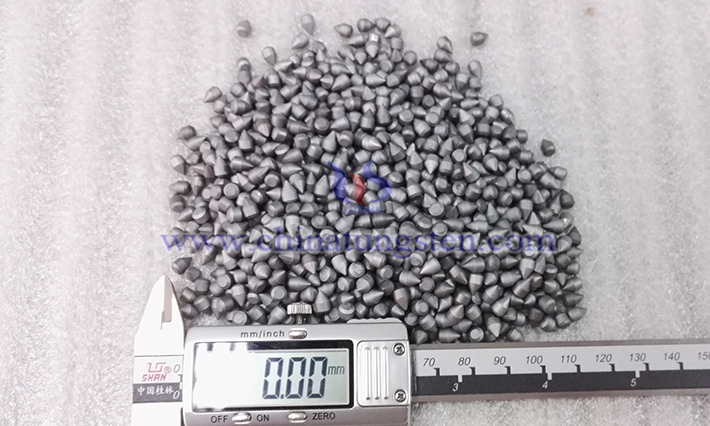
CTIA GROUP’s tungsten carbide safety hammer heads picture
4. Manufacturing Process of Tungsten Carbide Safety Hammer Heads
The production of CTIA GROUP tungsten carbide safety hammer heads follows the powder metallurgy process, which is standardized and mature. First, the raw materials are mixed: tungsten carbide powder and cobalt powder are combined in the required proportions, with a forming agent added, and stirred evenly to form a mixture. The ratio is controlled according to the product grade to ensure material performance. The mixture is then pressed into a green compact using specialized molds under high pressure, achieving a density of 50% to 60% of the theoretical density to ensure densification during subsequent sintering.
The pressed green compact enters the sintering stage, where it is densified under a vacuum or hydrogen-protected environment at 1,350°C to 1,450°C, allowing powder particles to fully bond and form the tungsten carbide matrix. Temperature and holding time must be controlled to avoid insufficient sintering or cracking. After sintering, precision machining is performed, including grinding and polishing of the tip and assembly surfaces, ensuring dimensional accuracy, surface finish, and proper fit with the hammer handle.
5. Applications of Tungsten Carbide Safety Hammer Heads
The applications of CTIA GROUP tungsten carbide safety hammer heads are mainly in emergency glass-breaking, while also covering some industrial auxiliary scenarios. In transportation emergency scenarios, they are mainly installed in vehicle-mounted safety hammers, bus escape hammers, and passenger ship window-breaking devices, used to break tempered glass and laminated glass, providing assistance for personnel escape in emergencies. Compared with traditional high-speed steel hammer heads, the glass-breaking efficiency is significantly improved. In public transportation scenarios, due to higher usage frequency, the hammer head’s wear resistance and impact resistance meet long-term use requirements, suitable for buses, subways, and passenger ships’ emergency escape configurations.
In industrial auxiliary scenarios, tungsten carbide safety hammer heads can be used for emergency breaking of construction glass and protective equipment glass, facilitating quick glass removal during equipment maintenance or emergency handling. They can also serve as auxiliary components for stone processing and metal specimen impact testing, suitable for high-hardness material impact operations. Their hardness and wear resistance reduce maintenance costs associated with component wear in these scenarios.