The types of tungsten carbide safety hammer heads produced and designed by CTIA GROUP can be classified based on structural design differences, mainly divided into two categories: integral and composite. Hammer heads with different structures differ in material distribution and applicable scenarios.
CTIA GROUP and its parent company, CHINATUNGSTEN ONLINE, have been dedicated to the tungsten-molybdenum products industry for nearly 30 years. They specialize in providing flexible, customized global services for tungsten-molybdenum products, designing, manufacturing, and precisely processing various standard specifications, grades, and dimensional precision according to customer requirements, suitable for a wide range of applications. For more information on tungsten carbide, please visit the website: http://www.tungsten-carbide.com.cn/index.html. If you require tungsten carbide, please contact CTIA GROUP: sales@chinatungsten.com, 0592-5129595.
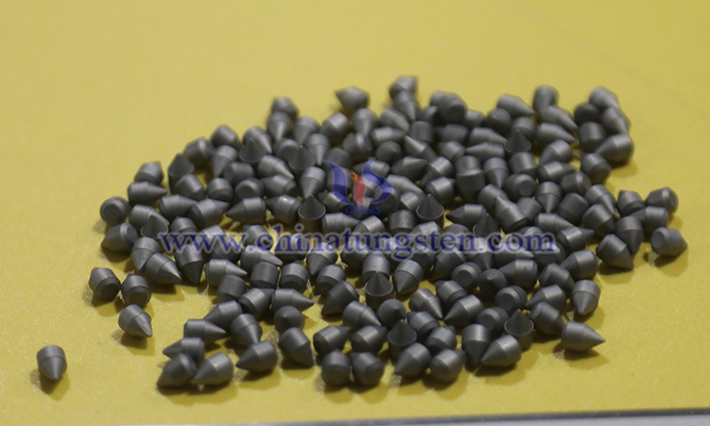
CTIA GROUP’s tungsten carbide safety hammer heads picture
The integral tungsten carbide safety hammer head is a single-piece tungsten carbide component, formed as one unit through powder metallurgy without any joint or inlaid structure. One end serves as a conical working tip, while the other end is the assembly section. This type of hammer head has uniform material, consistent overall hardness and wear resistance, with tip cone angles typically between 60° and 90° and tip radii of R0.5 to R1.5 mm. Its dimensions correspond to conventional hammer heads and are suitable for compact, lightweight safety hammer products. Commonly used material grades are YG6 and YG8.
The composite tungsten carbide safety hammer head adopts a “base + tungsten carbide working tip” combination structure and is currently the more widely used type. Its base is made of a more ductile alloy steel, while the working tip (conical end) uses a tungsten carbide block or rod, fixed to the base via brazing. This design balances the ductility of the base with the high hardness and wear resistance of the working tip. The size and position of the tungsten carbide working tip can be adjusted according to requirements to fit different safety hammer specifications.
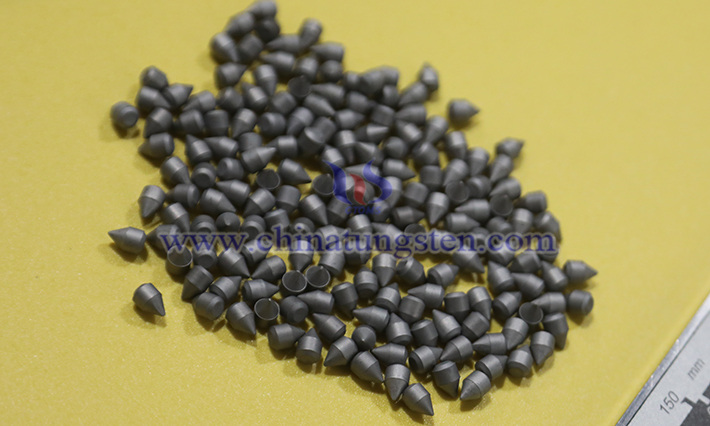
CTIA GROUP’s tungsten carbide safety hammer heads picture
The differences in application between integral and composite tungsten carbide safety hammer heads mainly stem from structural design, which affects performance emphasis and cost. The integral hammer head, due to its single material, has a relatively simple manufacturing process without the need for additional brazing, making dimensional accuracy easier to control. It is suitable for small vehicle-mounted safety hammers and portable emergency glass-breaking tools. However, its overall weight is slightly higher, and its cost is generally higher than that of composite hammer heads.
The composite hammer head, combining an alloy steel base with a tungsten carbide working tip, reduces cost while improving overall toughness and reducing the risk of chipping under impact. It is suitable for large public transportation emergency equipment, such as buses and passenger ships, as well as conventional industrial glass-breaking scenarios. Its service life is comparable to that of integral hammer heads, with lower maintenance costs.