CTIA GROUP’s grid-shaped tungsten alloy grating for production design is a precision radiation control component made primarily of tungsten alloy with a periodic grid array structure. It is mainly applied in X-ray systems to achieve functions such as scattered radiation suppression, beam collimation, or field shaping. Its structure consists of tungsten alloy grid walls with high radiation shielding capability alternately arranged with low radiation attenuation spacing areas, forming grid-shaped channels. Direct radiation can efficiently pass through the channels, while scattered radiation is effectively blocked by the tungsten alloy grid walls, thereby optimizing the radiation propagation path and improving imaging quality or radiation utilization efficiency.
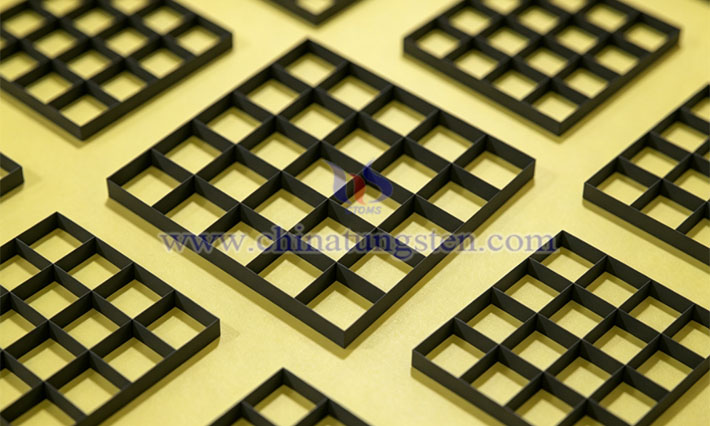
CTIA GROUP’s tungsten alloy grating picture
CTIA GROUP and its parent company, CHINATUNGSTEN ONLINE, have been dedicated to the tungsten-molybdenum products industry for nearly 30 years. They specialize in providing flexible, customized global services for tungsten-molybdenum products, designing, manufacturing, and precisely processing various standard specifications, grades, and dimensional precision according to customer requirements, suitable for a wide range of applications. For more information on tungsten alloy grids, please visit the website: http://www.tungsten-alloy.com/index.htm. If you require tungsten alloy grids, please contact CTIA GROUP: sales@chinatungsten.com, 0592-5129595.
1.Characteristics of grid-shaped tungsten alloy grating
CTIA GROUP’s grid-shaped tungsten alloy grating is primarily composed of metallic tungsten (tungsten content 80%–95%), with added binder phases such as nickel, iron, or copper, and low-density spacing materials such as aluminum or carbon fiber. It balances high radiation shielding capability with good machinability. Its density reaches up to 17.0–18.6 g/cm3, providing strong X-ray attenuation and effectively suppressing scattered radiation to enhance imaging contrast.
The tungsten alloy grating has a low thermal expansion coefficient, high mechanical strength, and large hardness. Combined with a high aspect ratio integrated grid structure, the load is evenly distributed, providing excellent deformation resistance and vibration resistance, and it can maintain dimensional accuracy over long-term use in complex environments. At the same time, it is wear-resistant and corrosion-resistant, has a long service life, and is non-toxic and non-radioactive, making it an ideal environmentally friendly replacement for lead-based gratings.
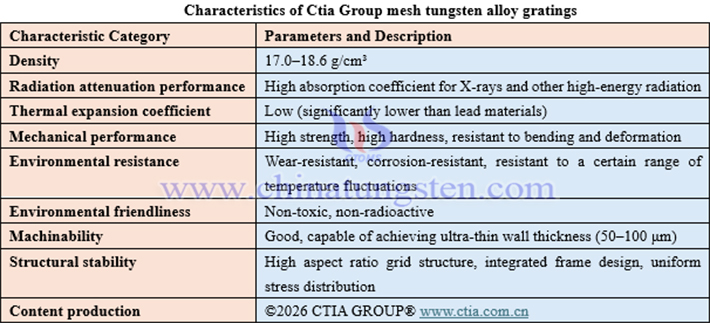
Characteristics of CTIA GROUP mesh tungsten alloy gratings
2.Geometric parameters of grid-shaped tungsten alloy grating
The geometric parameters of CTIA GROUP’s grid-shaped tungsten alloy grating mainly include grid bar spacing, grid wall thickness, grid height, aspect ratio, open area ratio, and focusing design.
In general, the influence of geometric parameters on the performance of grid-shaped tungsten alloy gratings is as follows: the smaller the grid bar spacing, the higher the radiation filtering precision, but the light transmission decreases; the thinner the grid wall, the higher the direct radiation transmission rate, but sufficient thickness is required to maintain scattered radiation blocking capability; the higher the grid height and aspect ratio, the stronger the suppression effect on multi-directional scattered radiation, which is the core advantage of the grid-shaped grating, but it increases manufacturing difficulty and reduces overall light transmission. The open area ratio affects the efficiency of direct radiation passage and system dose utilization. High-end applications often adopt focusing designs, which can effectively reduce edge cutoff phenomena and improve image uniformity across large fields of view.
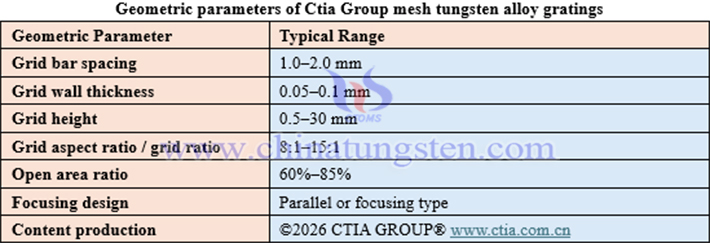
Geometric parameters of CTIA GROUP mesh tungsten alloy gratings
3.Working principle of grid-shaped tungsten alloy grating
CTIA GROUP’s grid-shaped tungsten alloy grating operates based on the principle of directional selective radiation shielding. When X-rays are incident, direct radiation propagating along the grid channel direction can pass through the low-attenuation spacing area with minimal loss; scattered radiation deviating from the main direction, whose angle exceeds the allowable range of the channel, is blocked by the high-density tungsten alloy grid walls, thereby reducing the interference of scattered radiation on imaging or radiation transmission, and improving image contrast or radiation utilization efficiency.
4.Applications of grid-shaped tungsten alloy grating
In modern medical imaging equipment, grid-shaped tungsten alloy gratings are widely used in medical digital radiography (DR), computed tomography (CT), mammography, and dynamic flat-panel imaging systems. They are usually installed in front of the detector as the core component of anti-scatter grids. The main function of the tungsten alloy grating is to effectively absorb multi-directional scattered radiation from human tissues through a two-dimensional grid array structure, significantly reducing the interference of scattered radiation on the detector, thereby greatly improving image contrast, clarity, and detail resolution. In clinical applications, this enhances imaging quality of bones, chest, abdomen, and other areas, helping doctors more accurately identify lesions and determine the extent of abnormalities, thus improving diagnostic accuracy and reliability.
In the field of industrial non-destructive testing, grid-shaped tungsten alloy gratings are widely used in industrial X-ray flaw detection equipment, especially suitable for detecting internal defects in castings, welded parts, forgings, pressure vessels, pipelines, and aerospace components. Installed in front of the X-ray detector, the high-precision two-dimensional grid structure effectively blocks multi-directional scattered radiation from inside the workpiece, significantly reducing interference from scattered radiation in imaging. Due to the high density and excellent attenuation performance of tungsten alloy, the grid-shaped grating can markedly improve the contrast and clarity of defect imaging, making small internal defects such as cracks, pores, slag inclusions, and lack of fusion more visible, thereby greatly enhancing detection sensitivity and accuracy.
In scientific research and precision detection, grid-shaped tungsten alloy gratings are widely used in X-ray diffractometers (XRD), synchrotron radiation facilities, high-energy physics detectors, X-ray astronomy detection equipment, and various precision spectrometer systems. They are typically installed at the front end of detectors or in beam channels, where the high-precision two-dimensional grid structure achieves radiation collimation and stray radiation shielding, effectively filtering multi-angle scattered radiation and background noise. Additionally, in cutting-edge research such as high-energy physics, material crystal structure analysis, and protein crystallography, the grid-shaped tungsten alloy grating, with its excellent structural stability, low thermal expansion coefficient, and interference resistance, can withstand long-term high-intensity radiation environments, maintain channel precision over time, and provide solid support for obtaining highly accurate experimental data.
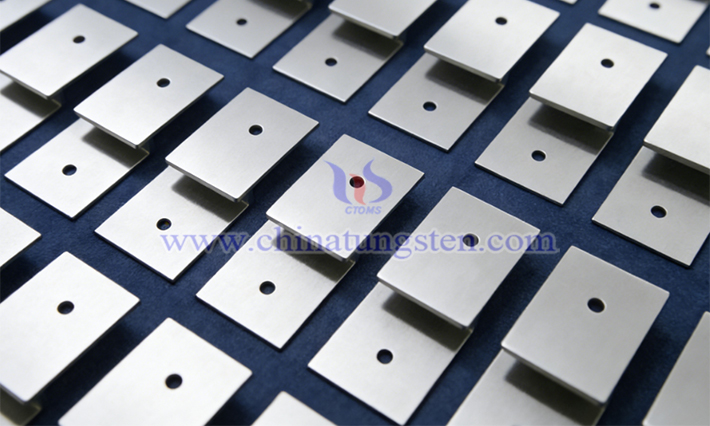
CTIA GROUP’s tungsten alloy grating picture
5.Comparison between grid-shaped and non-grid-shaped tungsten alloy gratings
CTIA GROUP’s grid-shaped tungsten alloy grating forms a closed three-dimensional grid array through perpendicular grid walls, effectively blocking multi-directional and multi-angle scattered radiation in two-dimensional space. Its scatter suppression capability is significantly stronger, structure stress distribution is uniform, deformation resistance is excellent, and long-term stability is high, making it more suitable for precision medical imaging and high-end industrial inspection in complex radiation environments requiring high resolution. However, its radiation transmission rate is slightly lower, manufacturing is more difficult, and cleaning and maintenance are relatively complex.
In contrast, non-grid-shaped tungsten alloy gratings use single-plane structures such as unidirectional slits or plate-type narrow slots. They have a simple structure, large transmissive area, high direct radiation transmission rate, easy manufacturing, lower cost, and convenient daily maintenance. However, their radiation blocking range is narrow, structural stability is weaker, and they are prone to deformation due to vibration or temperature, making them suitable for conventional industrial inspection scenarios with simple scatter conditions and moderate precision requirements.